
Wizards
A Historical-Ethnography of the Auto Shop Floor

By Zac Hyden and Graham Ingram
The first author has been an automotive technician off and on since he was 18 years old. He started out at a small shop in Huntsville, Alabama called Stringfellow Auto Repair. He has always loved automotive technology, but he has become increasingly convinced that the time of automobiles must come to an end. He has worked at independent shops, dealerships, and even ran a non-profit shop for five years called The Automotive Free Clinic that repaired vehicles for disadvantaged people at cost.
He recently ended a three month stint at a dealership as a technician because it was wrecking his mental health. There are extenuating circumstances because he has bipolar and major depressive disorder, but it posed a few questions. A) why are automotive technicians so stressed out? B) Why does the public, almost across the board, distrust automotive shops? And C) what historical factors have created the conditions that lead to poor technician mental health and distrust of shops among the public.
The central argument in our essay is that automotive repair shops are expected to not only repair vehicles, but society-wide problems of mobility, a mandate of which they are ill-positioned and ill-equipped to address and which is ultimately, remarkably unfair.
The methods of this essay are historical-ethnographic. We will contextualize the shop floor within a broader context of urban planning and environmental policy from the Post-War period to today. We will show that the trajectory of this policy environment has placed increasing pressure on automotive shops to address mobility issues through repair, which should, in fact, be addressed through policy, specifically, a move away from automotive centric urban planning and environmental policy.
We use five automobiles to define the eras of American mobility development, the Model T, the Chevrolet Bel Air, the Honda CVCC, the Toyota Corolla, and the Tesla Model S. The design of each of these vehicles reflects the policy and planning environment of their given time. They represent the singular choice to create a car-dependent society and the subsequent policy fixes for the unintended consequences of that choice, at each moment off-loading the responsibility for urban planning and environmental regulation onto automotive repair shops and technicians.
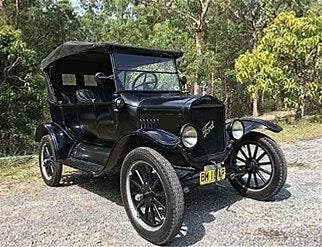
The Story of the Model T and the creation of Fordism
In its early stages the automobile was nothing more than a flex for the ultra-wealthy. Opulent, exorbitantly priced and by and large completely unobtainable for the common man. Every American kid knows what happens next, Henry Ford enters the picture with a practical, no frills mass produced tool for the masses. Turning the automobile from a luxury status symbol to the 20 horsepower beating heart of America.
When the first batch of model T’s hit the American consumer market in October of 1908 it debuted at a cost of about $850. Unlike the Packards, Pierce Arrows or Cadillacs of the era, the T didn’t feature ornate detailing, or coach like interiors. Instead it was a stripped down purpose-built tool built from lightweight vanadium steel. In addition to the light weight the T had higher ground clearance than competitors, a permanent switch to left side steering, and a reliable 2.9 liter inline 4 cylinder motor churning out a modest 20 horsepower. It was designed so that farmers could easily maintain and modify the vehicle, such as the engines removable head for easier maintenance. To test the durability of the vehicle Ford drove the T on a hunting trip to Wisconsin from Northern Michigan, proving the simple but rugged utilitarian design was well suited for the American roads (or lack thereof) that existed at the time. Though he had succeeded in bringing this marvel to market, Ford’s biggest breakthrough came in the T’s manufacturing system creating the modern template that made the automobile affordable to the everyman.
After two years of production Henry Ford moved the assembly plant to Highland Park Illinois in 1910, and by 1913 the T was made on Ford’s revolutionary assembly line. While it previously took about 13 hours to build the chassis of one T, by mid-1913 the line had assembly time down to just a little over two hours, slashing production costs. Ford chose to pass these production cost savings on to the customer and began to lower the price of the T, at a rate that competitors couldn’t match until the late 1920’s. Consumers would go on to purchase more than 15,000,000 model T’s and by the early 20’s more than half of all registered motor vehicles in the world were Fords, and by 1925 there were more than 17 million vehicles in the United States alone. This massive influx cemented the motor vehicle as an integral part of an American Society and its economy-and it was in no short part due to Ford’s strict pricing and revolutionizing the production system. Now the automobile was finally affordable and created the foundation for the modern supply chain. Still it wasn’t all work when it came to the model T. Soon Americans were traveling all over the country, in their “Tin Lizzie’s” thanks to other improvements in the form of the 1916 Federal Road act and the 1921 Federal Highway act. The actions along with the T’s affordability and reliability created the American tourist, leading to the creation of a whole new industry centered around the car. The Model T had altered how distance felt, how weekends were spent, and how American commerce now moved along new roads and highways.
The Model T wasn’t revolutionary because of its technology. It was revolutionary because of the production process that created it. By breaking up work into repeatable and routine work and creating the assembly line, Henry Ford created a production process that we all know well today. It turned work from a craft to something that someone with limited training could do easily. Big factories, with lots of workers doing routine tasks drastically increased the efficiency and lowered the cost of automotive production, so much so that the automobiles were no longer a luxury item, but available to all workers.
The name of this production strategy is, interestingly, called Fordism. The revolutionary nature of this production process can’t be understated. It changed the world, changed warfare, and put the automobile at the center of American life.
After the end of WWII, the United States had a mass of surplus industrial capacity. Europe was destroyed as was the Pacific. The US needed a solution to dispose of this surplus capital. The solution was the creation of the interstate highway system and suburbia, a car or two in every driveway and one of the hallmarks of American life, the morning and evening commute.
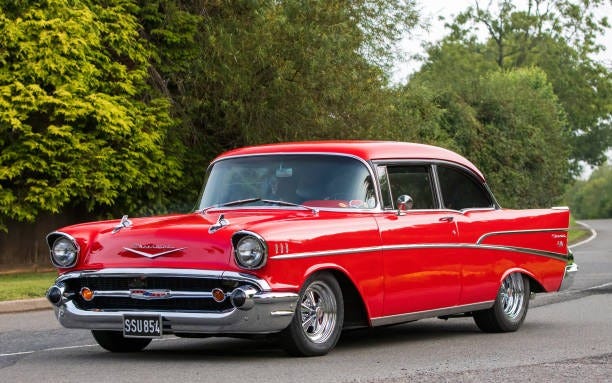
While Henry Ford had laid the foundation with the Model T, by the early 1930s competitors had caught up to Ford’s pricing points, and by the mid-1950s, the automobile was no longer just a utilitarian consumer good in the United States; it was part of the nucleus to the nuclear family, and these families wanted options. Gone were the days of Henry Ford’s, “Any customer can have a car painted any color that he wants so long as it is black,” this was the age of interstate travel and suburbia and for automotive manufacturers-the age of annual model changes, dealer financing, and special order packages. It was this environment that created the Chevy Bel Air.
The second generation Bel Airs began production in 1955, as the more upscale offering of the “Tri Five” lineup from Chevrolet. With late 50’s aerospace inspired styling, the 57’ Bel Air nameplate came in 16 color options, and with an optional convertible roof. It was offered with either the 235 cubic inch straight six, the 265 V8 or 283 “Turbo Fire” 2 barrel carb, and “Super Turbo Fire” 4 barrel engines, paired with the Turboglide 3 speed transmission, 2 speed Powerglide or standard 3 “three on the tree” manual. The Bel Air’s deeper importance was cultural. It became one of the defining cars of a generation, one that went cruising, to drive-in movies, and thanks to its comparatively light weight and formidable engine options, helped usher in a new generation of track, drag and street racing and hot rod culture in America.
While stylish and well equipped the biggest factor in the Bel Air’s cultural impact was timing. In 1956 President Dwight D Eisenhower signed the Federal Aid Highway Act creating the Interstate System and further expanding the role and importance of the automobile in American Society. With these newly built highways families were now taking their Bel airs cross country at a much faster rate than they had just 20 years before in their Ford model T’s. This speed revolutionizes America. Soon we’re living away from the cities and commuting, birthing the American suburb, and with the Bel Air serving as a physical status symbol of this new era. Indeed for the Bel Air it was only limited by how quickly the Interstates could be built. Still that didn’t stop Chevrolet from being innovative and experimenting with more economical technology. In fact the 1957 Bel Air was the first Chevrolet vehicle to be offered with mechanical fuel injection, Rochester Ramjet fuel-injection system-although the system was rare with only 68 known built and several accounts stating the system was too temperamental to be retained for the 58’ production model. Cars like the Bel Air were true to their time and a sign of things to come in the 60’s with manufactures engine displacements growing ever larger and the muscle car era shortly on the way. Fuel economy and emissions were not yet concerns because America had yet to experience an oil crisis, or EPA regulation, but just 13 years after the 57’ Bel Air helped to solidify the car as a cultural icon, American automobile culture would face its first real challenge—emissions and economy standards. Thus forcing the automotive industry to refocus research and development efforts on economy and compliance-rather than styling, performance, utilitarian design, or cultural impact.
Honda CVCC
By the time Honda released the Civic in 1973, the world was in the midst of the energy crisis and this newly formed American car culture faced it’s first real threat. Beginning with the Clean Air Act of 1970 automotive manufactures had to change their template. Gone were the days of 400 cubic inch behemoths and heavy curb weights. Instead emission standards, economy and efficiency were the name of the game. One of the first manufactures to figure out the new winning formula was Honda, and their Civic platform. Available in 1978 with either the 1.2L EB series inline 4 or the new 1.5L (ED1-ED4) CVCC. It was the latter engine that featured a brand new technology that not only met the new stricter admission standards, but because it was so successful, it ushered in a wave of fuel efficient reliable compacts in the American market. This began the shift from responsibility of individual vehicle owners for safety, maintenance, and pollution to that responsibility being placed squarely on automotive shops and specifically technicians. Technicians are now expected to solve societal problems like smog instead of those problems being solved by policy makers and planners.
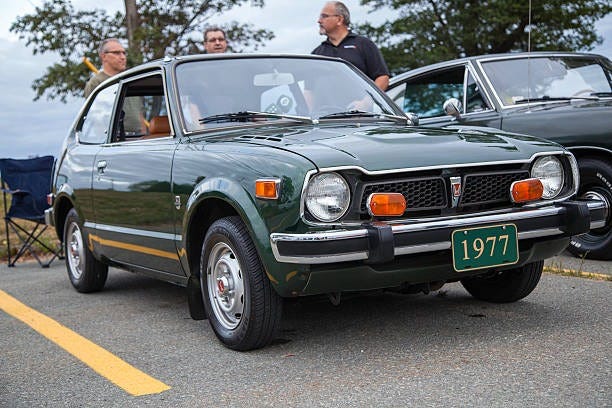
The 1978 Honda Civic was a child of necessity, the 1970 Clean Air Act amendments, the 1973–74 oil embargo, and the 1975 Energy Policy and Conservation Act that created Corporate Average Fuel Economy or CAFE standards that manufactures had to adhere too or the vehicles would be banned from American markets. It was in response to these standards that Honda first release its CVCC engines 1975, so named for their Compound Vortex Controlled Combustion system. The result of over $20 million worth of research and development into anti-pollution technologies the CVCC was a revolutionary technological that used a clever two-step burn system. Instead of mixing all the fuel and air the same way, it used a tiny extra chamber near the main cylinder. That small chamber got a slightly richer fuel mixture, which was easier to ignite. Once it burned, it created a flame that spread into the main cylinder and helped burn the leaner fuel mixture there more completely. Because the fuel burned more efficiently, the engine produced fewer emissions than many older engine designs. worked by lighting a small, easy-to-burn fuel mixture first. That small flame then helped burn the rest of the fuel in the engine more completely. This made the car cleaner, more efficient, and able to meet emissions rules without needing complicated add-on equipment. This advancement gave the Civic and other CVCC engine Honda’s of the era unparalleled economy and performance compared to some of their American and other competitors. The CVCC’s were cleaner, adhering to the new stricter emissions standards, but they didn’t sacrifice fuel economy to achieve this, in fact the design improved economy giving the Civic the title of most fuel economic vehicle in the US from 1975 to 1979.
In other words, CVCC did not matter only because it was “clean.” It mattered because it connected three things that the big three in Detroit had often treated as tradeoffs, emissions compliance, fuel economy, and affordability. That was a genuine technological breakthrough in the American market, not just an engineering success. In the Model T era, production scale signaled access; in the 1950s, style signaled prosperity; by the late 1970s, Honda made efficiency, and low emissions into a positive middle-class identity rather than a sign of compromise or inadequacy. It was this template that another Japanese manufacturer would use to dominate the American market about 8 years later, Toyota and their Corolla platform.
Toyota Corolla
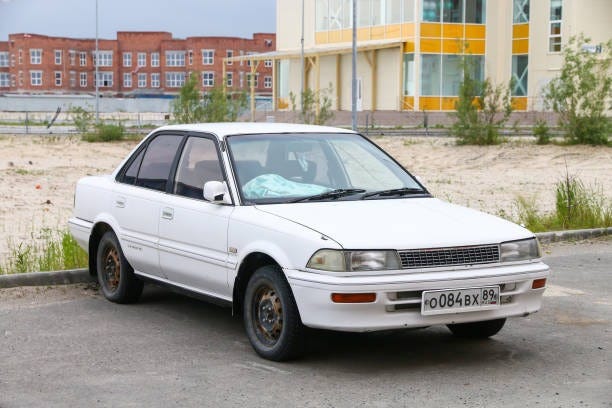
The 1988 Corolla belongs to a different moment in automotive history from the Civic CVCC. By the late 1980s, American consumers had already embraced the Japanese compact market. The question was no longer whether an imported compact could meet new regulations or survive an energy crisis. The new question was which company, and which flagship vehicle would come to define the coming era as we approached the 1990’s..
Following in Honda’s template from a decade earlier the 6th generation Corolla’s were a culmination of everything Toyota had learned throughout the regulation and gas price eras and became a long living testament to these lessons. It was the first year that both front wheel drive and EFI became standard for Toyota. While both of these technologies had been introduced as early as 1983; the sixth generation Corolla refined these technological developments. Equipped with the 4A-GE, 5A-F, or 2E inline four cylinders, and for 1988 a new EFI system that came standard. The 6th generation Corolla is still well known for its longevity and reliability, while still maintaining a modest amount of performance and peppy handling. The 1988 Corolla offered the kind of winning recipe for the coming age: efficient design, predictable drivability, good fuel economy, and enough performance to still feel fun. The 88’ Corolla could absolutely make a claim to being THE car that gave Toyota the legendary reputation for efficiency and ultra reliability that it’s still known for today. Americans loved this little subcompact import, but by 1988 the Corolla was feeling less like an import and more like a true American car, as Toyota even began manufacturing Corollas in the United States beginning in 1986, at the NUMII manufacturing plant in Fremont California.
The Corolla’s social effect followed from its ordinary reliability. It became a favorite commuter and small-family car in a period when Americans increasingly valued durability, and better fuel costs over performance or flash. In short Americans bought Corollas because they wanted predictable, uneventful vehicles. With simple styling,and just enough technology to make reliability and efficiency feel standard. That is why the 1988 Corolla matters for American automotive history: it helped make quality led reliability become Toyota’s best selling point.
Tesla Model S: EVs and ADAS
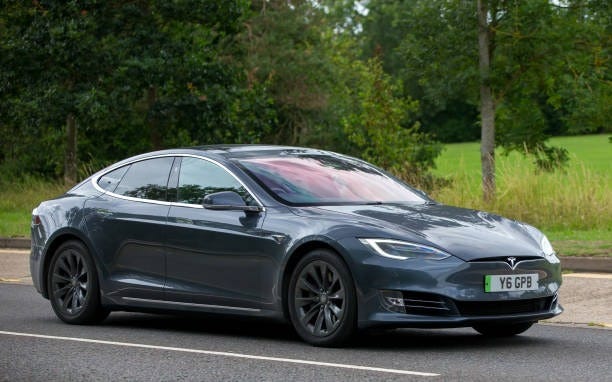
Tesla launched what is arguably the most successful electric car in history - the Model S. Tesla started delivering vehicles to customers in 2012. Three years later they launched Autopilot, a self-driving car system. To say that Tesla ushered in a new era of automotive technology would be an understatement. Their vehicles are loaded with the latest tech, from SONAR, LIDAR, RADAR, and Camera driven advanced driver assist systems, or autonomous vehicle systems, and by 2018 most vehicle manufacturers were adopting some version of this technology for their own vehicles.
EVs are much simpler than internal combustion engines have become over the years because of increasing environmental regulation. They often consist of a large battery, a motor-generator that drives the vehicle and charges the battery on deceleration, a gearbox, and inverters to transform alternating current into direct current or high voltage direct current into low voltage direct current to run the accessories. What is more complex about these new vehicles are the self driving systems that are being attached to all of them.
Currently, Chevrolet with SuperCruise and Tesla’s Autopilot are the most comprehensive systems in use, allowing for full self-driving on most highways. The main reason that self-driving vehicles have become part of automotive technology is that they are significantly safer than human-driven vehicles and the costs of vehicle accidents are exorbitant. However, as with anti-lock braking systems and supplemental restraint systems (airbags), the responsibility for vehicle safety has now been offloaded onto technicians and repair shops and the technology is something in which few of them are trained. There is even little responsibility on vehicle owners because the tech operating and being repaired correctly falls squarely on technicians.
The Ethnography of the Auto Shop Floor
“People have no idea how stressful it is to be a tech.” - Danny, Lexus Tech
The shop floor in an auto shop has an us-against-the-world flavor. Techs are gruff, ornery, swear often, and constantly give each other crap about everything from sexuality to age. It’s not a politically-correct place. It’s almost exclusively men owing to the extremely physical nature of the work, but also because of shop floor discrimination of women and trans technicians. The work is physically and intellectually demanding. Add to this unrealistic customer expectations, flat rate, and sometimes bad management, and the shop floor is a pressure cooker.
People get into auto repair because they like solving puzzles and repairing things as Sandra argues,
People end up here because they like puzzles and are drawn to solving them.
They get burned out by not having a structure that cares about or nurtures them; then by moving place to place desperately looking for normalcy.
The development of automotive technology over the past 70-odd years has progressed from vehicles that can for the most part be repaired in a driveway to a highly specialized, technical field that requires knowledge broader and deeper than any PhD. Technicians have to have a working knowledge of chemistry, physics, geometry, fluid dynamics, electronics and electricity, and increasingly, SONAR and RADAR in advanced driver assist systems (autonomous driving systems).
Technicians are also paid by the job. Each job is rated for flat rate hours and the technician gets paid based on those hours. If the tech beats the time, they still get the total hours, but if it takes longer, they only get the rated hours. As vehicles get more complex and customers push to pay less and less, especially for diagnostics, it gets harder and harder to beat the time. Some technicians do; many don’t. This also does not take into account that technicians must purchase their own tools, which can run in the range of $10,000-$50,000.
Jamal complains about flat rate and management,
It’s really bad when you make commission or flag hours, and the managers and service writers short you on labor just to make a sale. Or the manager won’t update the shop’s scanner so that you can work on the diagnostic ticket that he just handed you. Or you spend 2 hours diagnosing a vehicle only to have the service writer waive the 1 hour diagnostic fee to make the sale, so that’s 2 hours you’re not getting paid for. I have a million stories like this from 30 years in the business.
And Mike vents his frustrations about tools and diagnostics,
Add to that always having to buy new tools, customers wondering why diagnostics are not free, and not understanding when you tell them that your scanner costs $3000 and the money doesn’t just magically appear.
Technicians report high levels of dissatisfaction with three aspects of auto repair in particular - customer expectations, flat rate, and bad management.
For instance, George, a one man shop owner, stated about customer expectations,
I’ve never given much thought to mental health. To me the reality is sometimes it just sucks and you have to grit your teeth and move forward. However, it does take a toll one. I am a one man show. Last summer my average car count was 75 vehicles. Of those, at least 60 of the owners would call twice a week looking for an update on their vehicle. Finally one day I kept up with the amount of time I spent on the phone and it was almost 4 hours. Meanwhile I’m there until almost 10 pm and back up and in the shop at 3 am. It sucked the life out of me. My building collapsed in the ice storm in January, and I was able to tell people don’t bring it, I can’t do it. The shop collapsing actually made me feel relieved. Now as summer is coming along again, the pressure is building up again. I understand everyone needs their car fixed, but the pressure they put on us as techs to get them fixed is unbelievable. So all in all, is my mental health great? Probably not. What do I do about it? I’m not sure. So far, just grit my teeth and dig a little deeper.
Jason argued that just paying attention to technicians could be therapeutic
A lot of us find ourselves under a great deal of stress and pressure, and we feel like we have no place to vent. Maybe just filling out the survey will itself be therapeutic, like finally someone will hear us and maybe care.
Not only do technicians feel extreme stress to repair vehicles correctly and safely, many feel that no one cares or is listening to our struggles. It is common for people to complain about the price of automotive repair or that automotive shops are scamming them; yet, technicians are clearly having mental health issues because of unrealistic customer expectations. No one is happy.
Let us digress for a moment and discuss the incredible complexity of modern vehicles. Modern vehicles have 40-70 computers, which are all connected on a network called the CAN-BUS. CAN stands for controller area network. If one of these computers or one of the dozens of sensors connected to them is not functioning correctly, it sends a light to the dash. Technicians must dig into these complex electronics to diagnose them, often while customers wait in the lobby, and often without much pay because, as stated above, customers do not want to pay for diagnostics, which is understandable because the price is $150-$200/hour just to figure it out. A five hour diagnosis is a large bill and that’s not even the cost of the repair.
The situation is intractable. Customers need their vehicles to get to work, school, doctors, office, grocery store, in a word, everywhere. We are a car dependent society. Technicians need time and money to repair vehicles, neither of which the public has much of. The shop is a pressure cooker.
This condition is not the result of bad choices by consumers or repair shops, but the result of dozens if not hundreds of policy choices regarding mobility over the last 70-odd years. The first was to create an automobile dependent society with the creation of suburbia and the interstate highway system, which created poor air quality in large cities, which led to environmental regulations and the increasing sophistication of automobiles to regulate emissions and deal with a very real threat of climate change. But, every policy decision has placed more onus on automotive repair shops and specifically technicians to solve society-wide mobility issues that we are neither equipped to or positioned for addressing.
The only solution is a future without automobiles and this is not a technician or consumer question, but a policy and planning question. Enter Toyota’s Woven City.
Conclusion:
The Woven City: Toyota’s Future of Mobility
We’ll just let Toyota speak for themselves.
Toyota is redefining what it means to move. We’re challenging the current state of mobility by enhancing the movement of people, goods, information and energy. Centered around three core concepts - A Living Laboratory™, Human-Centered, and Ever Evolving City™ - Woven City serves as a test course for mobility to fulfill our purpose of well-being for all.
We do this by bringing together a diverse community of people with a shared passion for the future of mobility to co-create, develop and refine innovative products and services. This cross-section of social infrastructure, mobility, and people provides a unique opportunity for inventors, residents and visitors to interact seamlessly with new technologies throughout daily life in an environment that emulates a real city.
The Toyota name began changing the world long before it became globally renowned in the automobile industry. Toyota’s founder Sakichi Toyoda, determined to ease his mother’s countless hours working on a manual loom, revolutionized the textile industry with numerous inventions that drastically improved the lives of others. From looms to automobiles, and now Woven City, the philosophy “for others” continues to be the driving force behind our initiatives
The website for Toyota’s Woven City is conspicuously absent of automobiles and it appears that Toyota is preparing to pivot from automobile manufacture to building sustainable cities and urban design. Climate change and pollution is an urban design issue and building settlements around automobiles has gotten us a destroyed world. Toyota apparently sees that without solving climate change, there’s no world left to profit from and that the only way out is to design different ways of living.
Wow. A great article. The ‘56 bel air V8 was our family car (those days when not every single person needed a car) that i was very happy to learn on.
You guys are doing a great service (pun intended) by writing about this. Thanks
Excellent! Love the history through cars and their social effects. I wrote my thesis on urban/suburban environmental history so this is super cool to read, plus the labor aspect. I can't imagine how alienating it has to be to be squeezed by the bullshit imperatives of the market. Even if techs have the skills, like everyone under neoliberalism, they're gonna be treated like dogshit and asked to make compromises that are shortcuts and/or morally wrong.